INSIGHT
The user problem
Salon owners juggle 4–6 disconnected tools daily, from paper appointment books to WhatsApp reminders and spreadsheets. Manual scheduling creates double-bookings, missed slots and a no-show rate averaging 23%.
Product design case study · SalonOS AI
A unified salon operations platform connecting appointments, customers, staff, marketing and AI assistance into one clearer daily workspace.
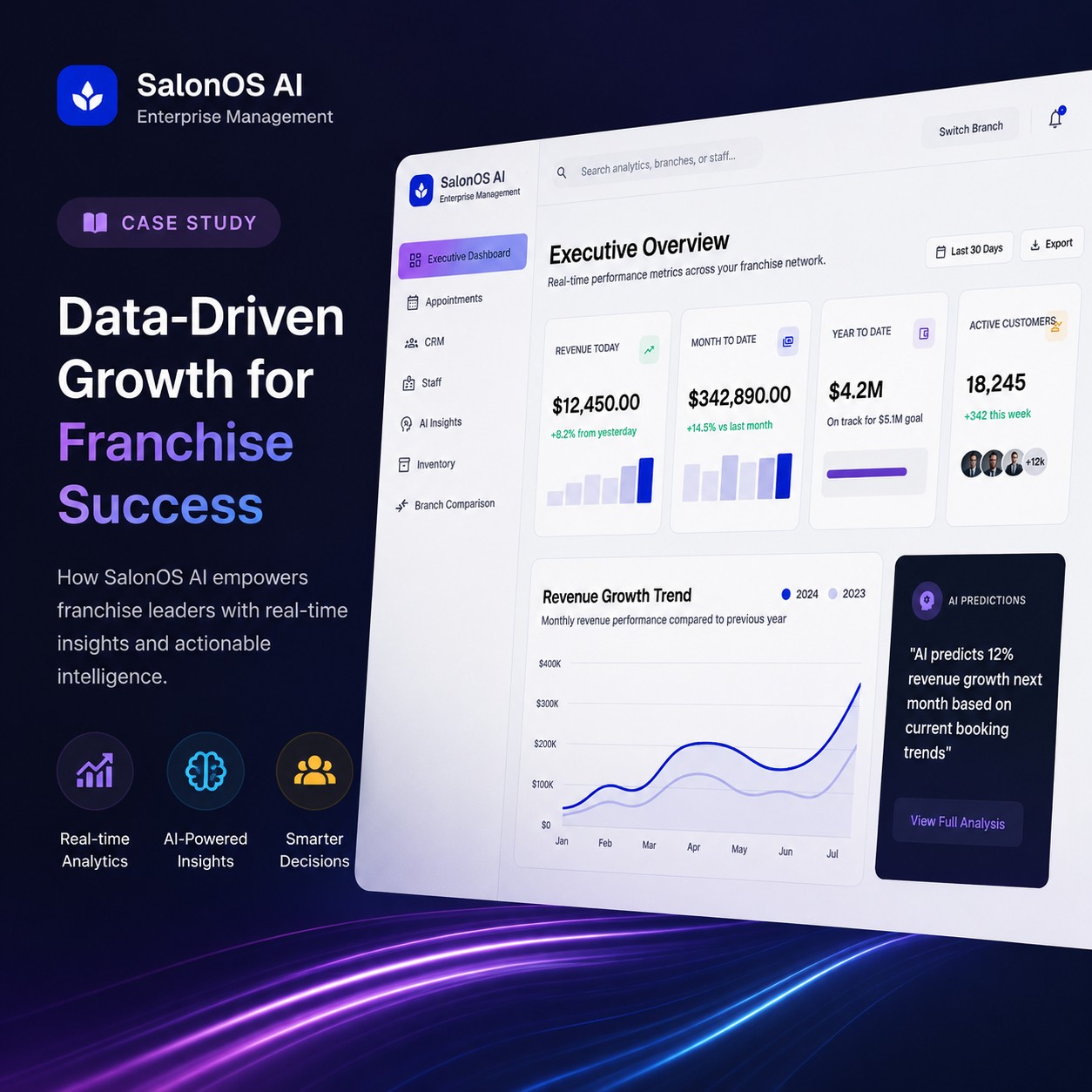
A unified operating system for modern salons.
INSIGHT
Salon owners juggle 4–6 disconnected tools daily, from paper appointment books to WhatsApp reminders and spreadsheets. Manual scheduling creates double-bookings, missed slots and a no-show rate averaging 23%.
INSIGHT
Revenue leakage comes from missing upsell triggers, loyalty tracking and churn signals, while staff performance and commission accuracy remain difficult to see. Marketing teams also lack targeted re-engagement, seasonal promotion and loyalty tools.
Manual scheduling leads to double-bookings, missed slots and high no-show rates averaging 23%.
No upsell triggers, no loyalty tracking, and no clear view of customer lifetime value or churn signals.
No visibility into stylist utilization, performance metrics or commission accuracy across the team.
No simple way to run targeted re-engagement campaigns, seasonal promos or loyalty rewards.
The opportunity was not simply to add more salon software. It was to connect daily operations, retention and growth into one coherent system.
PERSONA
Mahirah S, 22, owns two salon locations in California. She spends three hours every morning handling bookings, WhatsApp messages and payments. Her priorities are operations, revenue, staff management and growth.
PERSONA
Jessica, 28, is a marketing professional in Boston. She wants to book her stylist in 30 seconds, receive reminders, keep visit history and get useful loyalty or personalized recommendations.
No centralized revenue-vs-target view; manual stylist performance and commission tracking; customers lost after the first visit; difficulty identifying slow days for promotions.
Calling to book feels outdated; no real-time stylist availability; loyalty points are inconsistent; recommendations do not reflect previous visits.
SalonOS AI combines AI, CRM, marketing and analytics in one workspace, positioned mid–premium against Vagaro, Fresha, Mindbody and Booksy.
| Platform | AI Features | CRM | Marketing | Analytics | Price Point |
|---|---|---|---|---|---|
| SalonOS AI · Ours | Full AI | Full | Full | Full | Mid–Premium |
| Vagaro | Limited | Full | Partial | Partial | Mid |
| Fresha | None | Partial | Full | Partial | Free + Commission |
| Mindbody | Limited | Full | Full | Full | Premium |
| Booksy | None | Partial | Partial | None | Low–Mid |
SALON OWNER
“I spend 3 hours every morning handling bookings, checking WhatsApp messages, and chasing payments. I need to run my business, not manage tools.”
SALON CUSTOMER
“I want to book my stylist in 30 seconds on my phone, get a reminder, and know my visit history is saved for next time. That's all I ask.”
The Figma work makes the strategic model tangible: the operating-system architecture connects owners, managers and staff while the supporting analytics establish a path from operational data to business growth.
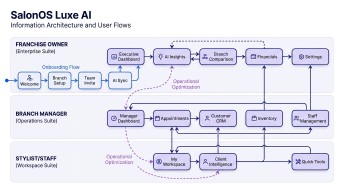
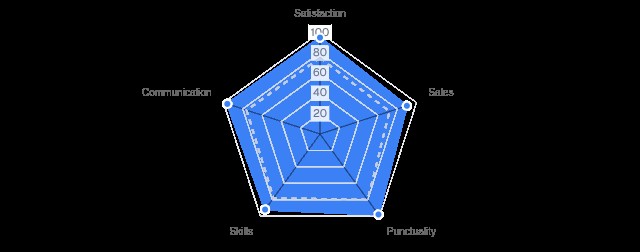
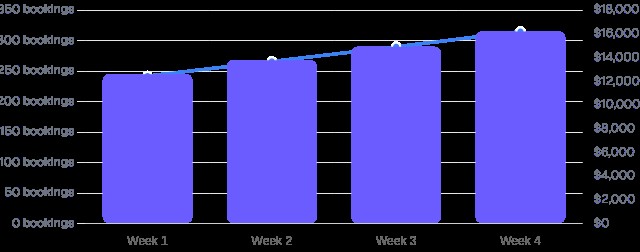
The customer journey connects discovery to retention, making every operational touchpoint part of the product strategy.
| Stage | Touchpoint | User state | Product response |
|---|---|---|---|
| Discover | Google / Word of mouth | Curious | Clear salon discovery and service entry points |
| Explore | Browse services + stylists | Interested | Services, profiles and availability in context |
| Select Stylist | Profiles + reviews | Confident | Trust signals and stylist context |
| Book Slot | AI-suggested timing | Satisfied | Reduce scheduling friction |
| Confirmation | SMS + email | Delighted | Instant confirmation |
| Reminder | 24h + 1h before | Prepared | Reduce no-shows |
| Visit | Smooth check-in | Happy | Keep service experience simple |
| Pay | Cashless + tip option | Easy | Complete the visit without friction |
| Loyalty | Points + rebooking nudge | Retained | Turn completed visits into repeat behavior |
Business outcomes were translated into a focused opportunity tree and a navigation model that supports daily salon work.
OPPORTUNITY SOLUTION TREE
→ Increase Customer Retention · Improve Booking Completion Rate · Reduce Administrative Workload
→ AI Booking Engine · Smart CRM · Marketing Automation · Analytics Dashboard
INFORMATION ARCHITECTURE
Executive overview and daily signals.
Calendar, waiting list, reschedule/cancel.
Profiles, history, loyalty, segments and tags.
Roster, availability, performance and commission.
Campaigns, automated flows, reviews and ratings.
Revenue analytics, AI insights and export.
Configuration and operational controls.
Features were ranked by Reach × Impact × Confidence ÷ Effort, then sequenced into build phases.
High reach, high impact, immediate need.
Drives retention and LTV growth.
Re-engagement and seasonal campaigns.
Product stock prediction and reordering.
Enterprise tier feature, intentionally later.
| Phase | Focus | Scope |
|---|---|---|
| Phase 1 · Q1 | Booking Experience | AI-powered booking flow, stylist profiles, SMS reminders |
| Phase 2 · Q2 | CRM & Loyalty | Customer profiles, loyalty points engine, visit history |
| Phase 3 · Q3 | AI Insights | Revenue dashboards, predictive analytics, churn detection |
| Phase 4 · Q4 | Automation Layer | Campaign builder, Inventory AI, multi-location |
The high-fidelity Figma work connects the strategy to an actual operating workspace rather than presenting isolated UI.
Every AI touchpoint follows a responsible design loop rather than black-box automation.
User action triggers AI context.
Pattern recognition on historical data.
Predict, suggest or automate.
Owner reviews before critical actions.
Executed with a feedback loop.
Predicts the next booking time from client history, suggests an optimal stylist pairing and fills gaps in the schedule.
Analyzes visit patterns and suggests add-on services at checkout with personalized copy and timing.
Detects dormant customers after 30 days, triggers personalized re-engagement SMS with a discount offer and tracks conversion.
Dashboard, appointments, customers and AI insights work as one workspace.
INSIGHT
Revenue, appointments, staff and actionable signals give owners a fast start to the day.
INSIGHT
Calendar view, waiting list and reschedule/cancel workflows keep booking operations together.
INSIGHT
Profiles, visit history, loyalty and segments connect service history to retention.
INSIGHT
Patterns identify growth opportunities and reduce manual operational work.
The interface had to make a complex operating system feel approachable.
DECISION
Group appointments, customers, staff and growth around clear jobs.
DECISION
Use reach, impact, confidence and effort to sequence features.
DECISION
Show what the system recommends and why.
DECISION
Every insight should lead to an understandable next step.
As a concept case study, these are post-launch success criteria and target outcomes rather than measured results.
| Metric | Before | Target |
|---|---|---|
| Booking Completion | 78% | 90% |
| Repeat Customers | 35% | 55% |
| Staff Utilization | 62% | 80% |
MEASUREMENT FRAMEWORK
AI Booking Engine → Faster Booking → More Completed Appointments → Booking Completion Rate
CRM + Loyalty System → More Returning Customers → Higher Retention → Repeat Customer Rate
Every feature is tied to a measurable business KPI, showing outcome-driven product thinking rather than feature-driven design.
The system is intended to scale from a single salon to an enterprise multi-location chain without visual debt.
Token-based colors, radius, spacing and typography create repeatable product patterns.
Information is structured around the actions and signals salon operators need most.
The product model is designed to remain coherent across operational contexts and screen sizes.
The project demonstrates an end-to-end product design lifecycle and a responsible approach to AI.
From problem discovery through OST, user research, journey mapping and IA, the work covers a full product lifecycle rather than only UI output.
Human-in-the-loop controls keep owners responsible for consequential decisions and make automation easier to trust.
Salon owners do not need more features. They need fewer manual tasks and better operational visibility.
AI should simplify workflows, automate repetitive actions and support decisions rather than replace human expertise.
NEXT STEPS
Conduct moderated usability testing with 5–8 salon owners, run A/B tests on the booking flow, validate AI feature adoption and track real-world KPI performance.
Each major design choice connects a user problem to a product or business outcome.
| Problem | Solution chosen | Why it matters |
|---|---|---|
| Missed Appointments | AI Reminders & Follow-ups | Reduces no-shows and protects revenue |
| Low Customer Retention | Loyalty + Personalized CRM | Encourages repeat visits and increases LTV |
| Manual Marketing Tasks | AI Campaign Automation | Saves time and improves engagement |
| Scheduling Complexity | Smart Calendar & Staff Allocation | Optimizes utilization and customer experience |
The product model keeps user impact and business impact connected.
| Feature | User impact | Business impact |
|---|---|---|
| AI Reminder System | Fewer missed appointments | Revenue Growth |
| Loyalty Engine | More repeat visits | Higher Customer Lifetime Value |
| Automation Tools | Improved staff efficiency | Operational Savings |